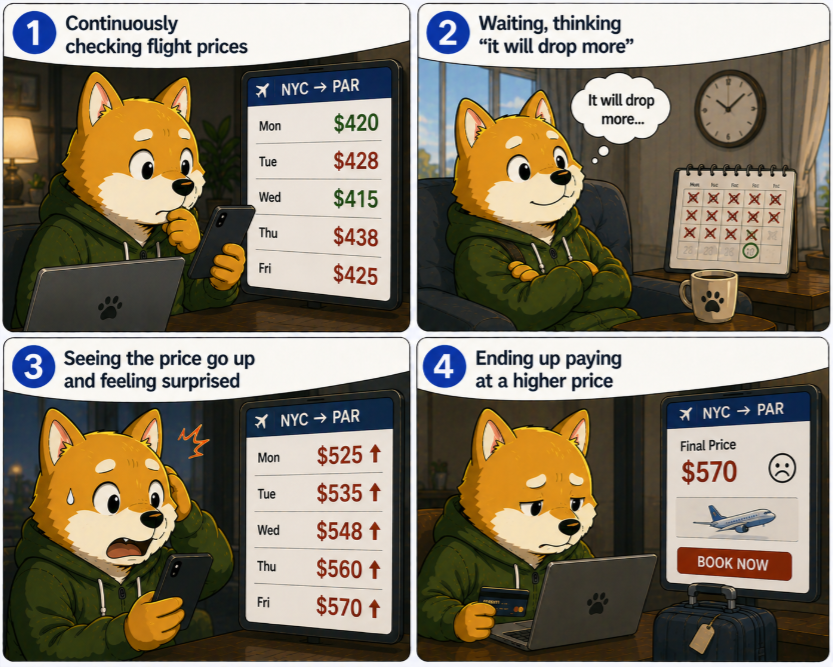
You keep checking flight prices.
It went up from yesterday.
You wait because it feels like it will drop again.
And a few days later,
it becomes more expensive.
This is not an algorithm issue.
It is a decision delay issue.
Q. Isn’t the price going up because I check it too often?
A.
Many people think that. I used to believe that if I kept checking the same flight, the price would go up. So I changed browsers, cleared history, and even checked on different devices.
But one day, I checked the same flight at the same time with a friend, and the price was identical. Even on different devices, it was the same. That’s when I started to question it.
After watching for a few days, I saw the pattern. The price didn’t go up because I looked at it. It went up because seats were being sold.
Once the cheaper seats were gone, it moved to the next price tier.
What I realized was simple.
This was not driven by individual behavior. It was driven by overall demand.
So this is what I do.
I don’t assume it’s caused by my actions.
Q. Then what is the real reason prices change?
A.
It is the seat structure.
Flight prices are not a single price from the beginning.
Even within the same flight, prices are divided into multiple tiers.
I once tracked the same flight continuously.
It was 420 dollars at first, then went up to 480 dollars.
It didn’t simply increase. The cheaper seats were sold out.
The remaining seats belonged to a higher price group.
After seeing this, my criteria changed.
The price wasn’t moving. The seat category was changing.
So this is what I do.
I judge based on remaining seat conditions, not just price.
Q. Doesn’t clearing cookies or using incognito mode make it cheaper?
A.
It has almost no effect.
I tested it myself.
I compared the same flight on a normal browser, incognito mode, and different devices.
The results were almost identical.
Sometimes there were small differences, but that was due to exchange rate display or caching.
The core pricing structure did not change.
What I realized was this.
This is not a technical issue. It is a structural issue.
So this is what I do.
I don’t waste time clearing cookies.
Q. Do prices ever go down?
A.
Yes.
But it is very hard to predict.
It depends on competitor pricing, demand changes, and promotions.
I once waited because I thought the price would drop, but it went up instead.
I tried to save 30 dollars and ended up paying 90 dollars more.
After experiencing this multiple times, my thinking changed.
This is not a game you can win.
It is a structure where you miss timing.
So this is what I do.
I don’t wait to match the price.
Q. Then when is the right time to buy?
A.
When the price is acceptable.
There is almost never a perfect lowest point.
If you keep comparing, you end up being late.
Now I have one rule.
If it feels reasonable, I buy immediately.
If the price is acceptable, book it and stop checking
That’s how I avoid paying more by waiting too long.
So this is what I do.
I don’t chase the perfect price. I decide at a reasonable price.
Q. What is the most common mistake people make?
A.
Thinking they can control the price.
I used to keep checking and trying to find a better deal.
But in the end, I often paid more.
What I realized was simple.
This was not an analysis problem. It was a decision problem.
So this is what I do.
I don’t try to beat the price.
Q. Then how do you summarize the conclusion?
A.
It’s simple.
Prices move.
Seats decrease.
This is not an algorithm issue.
It is a structure.
So this is what I do.
If the price is reasonable, I book immediately without waiting.
Published date
2026-05-06