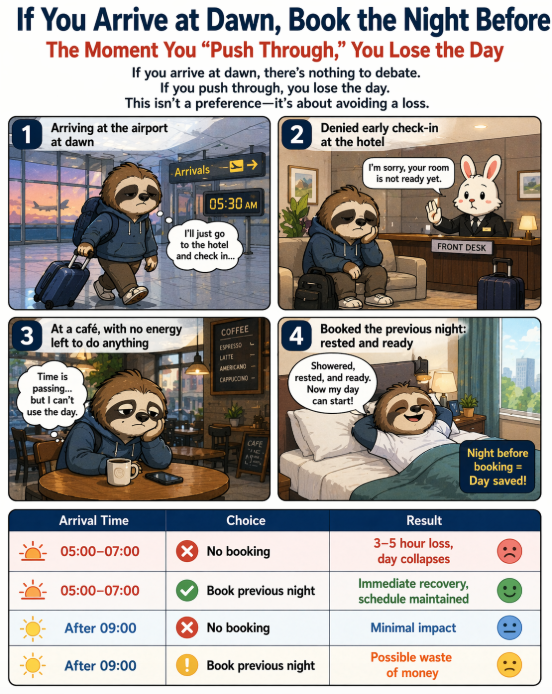
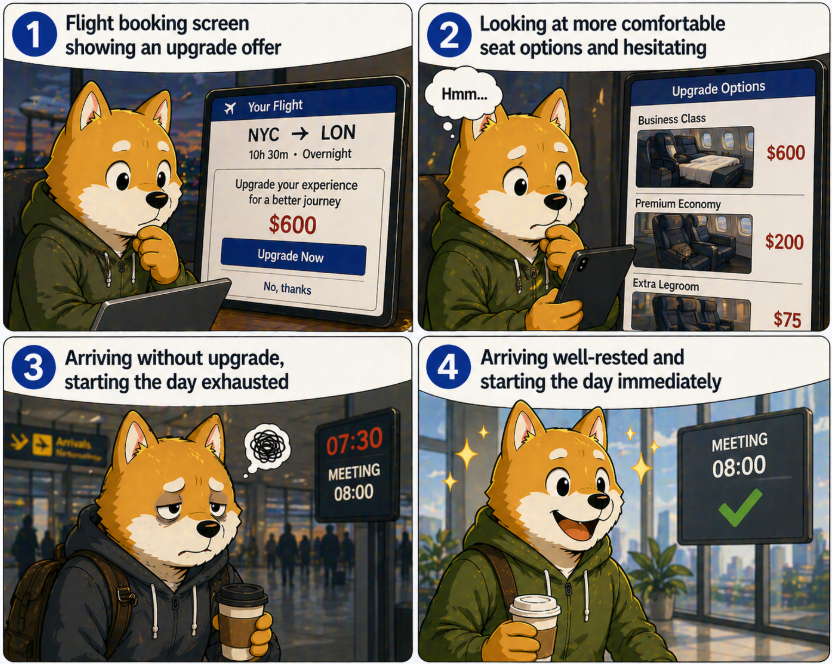
I arrived at 7 AM.
Check-in is at 3 PM.
My body is already exhausted.
At this moment, one choice appears:
Should I use a day-use room or not?
This is not about comfort.
It’s the moment you decide whether to spend money to save your day—or just endure it.
Q. When do people start considering day-use hotels?
A.
It’s almost always the same situation. You arrive early in the morning, but no rooms are available. You think sitting down will be enough, but after 30 minutes, your body feels even heavier.
Especially after a long-haul flight, sitting is not rest—it actually makes you more fatigued.
Then the front desk says:
“You can use a room from 9 AM to 3 PM. It’s $150.”
At that moment, it feels like a solution. I thought so too. I paid immediately and went in.
But reality was different. I washed up, lay down, and time passed quickly. Soon I had to prepare to check out again.
In reality, I rested for just over an hour.
That’s when I realized one thing:
This wasn’t rest—it was buying fragmented time with money.
So this is my rule: I don’t pay for day-use just because I’m tired. I calculate the actual usable time first.
Q. Then when does this choice actually have value?
A.
There is only one criterion:
Does that rest change the outcome?
For example, if you have an important meeting or schedule that day, the situation changes. Entering in a fatigued state leads to slower thinking and poor decisions. I once missed something critical because of that.
On the other hand, even two hours of proper rest can completely change your condition. The same person produces a different result.
In that case, $150 is not expensive—it is the cost of preventing loss.
So this is my rule: if today’s outcome matters, I spend the money. If not, I endure.
Q. What is the most common mistake people make?
A.
They misjudge time. They think they will rest for four hours.
But in reality, after check-in, settling in, and preparing to leave again, you are left with about one and a half hours. That is not enough for deep rest, and it only breaks your rhythm.
I once had three hours before heading to the airport and used a day-use room. I ended up more tired. Moving, settling in, and moving again made my body heavier.
So this is my rule: if I cannot secure at least four hours, I do not use it at all.
Q. Does luggage storage change the situation?
A.
Completely.
Without luggage, your mobility improves significantly. You can sit at a café, go to a lounge, or simply rest while managing your time slowly.
Once, I stored my luggage and spent three hours at a nearby café. It cost about $10. Same time—but a completely different outcome.
In this case, day-use is almost unnecessary.
So this is my rule: if I can store my luggage, I immediately exclude day-use.
Q. How does it compare to booking the previous night?
A.
This is something many people overlook.
For example, if a previous-night stay is $240 and day-use is $150, day-use looks cheaper.
But if you arrive at 6 AM, you still have to wait three hours before day-use begins. You cannot rest immediately.
With a previous-night booking, you check in right away and lie down immediately. The recovery itself is completely different.
After experiencing this difference, I changed my 기준 → standard. If I arrive early in the morning, I do not consider day-use first—I look at booking the previous night.
So this is my rule: for early morning arrivals, I do not try to save money—I choose immediate rest.
Q. So how should you decide in the end?
A.
This is not a matter of thinking—it is a matter of conditions. The answer is already determined.
| Situation | Choice | Result |
|---|---|---|
| Less than 3-hour gap | Use day-use | Poor value for cost |
| 4–6 hour gap + fatigue | Use day-use | Recovery possible |
| Luggage storage available | Do not use day-use | Cost saving |
| Early morning arrival | Book previous night | Immediate recovery |
My standard is now clear.
If today’s outcome matters, I spend money.
If not, I do not spend it.
So this is my rule:
If today’s schedule is important, I book immediately. If not, I simply endure.
Published Date
2026-04-20