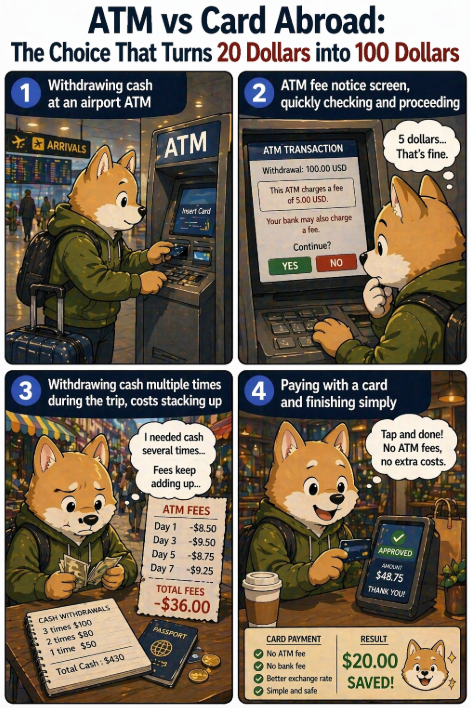
You insert your card into the ATM.
Cash withdrawal failed.
You try again.
Failed again.
From that moment,
the issue is no longer cash.
It is losing access to your own money.
This is not an ATM issue.
It is an issue of what you do next.
Q. If an ATM withdrawal fails abroad, shouldn’t you just try again?
A.
Most people react that way. I used to repeatedly try at the same ATM.
But abroad, that often made the situation worse.
Once, an airport ATM declined my withdrawal, and I kept retrying with different amounts.
The result was repeated failure.
Later, I found out the bank had already triggered a security block, and repeated attempts made the block even stronger.
What I realized was simple.
This was not a withdrawal failure. It was a blocked access path.
So this is what I do.
If an ATM fails once, I don’t repeat at the same machine.
Q. What should you do first after an ATM failure?
A.
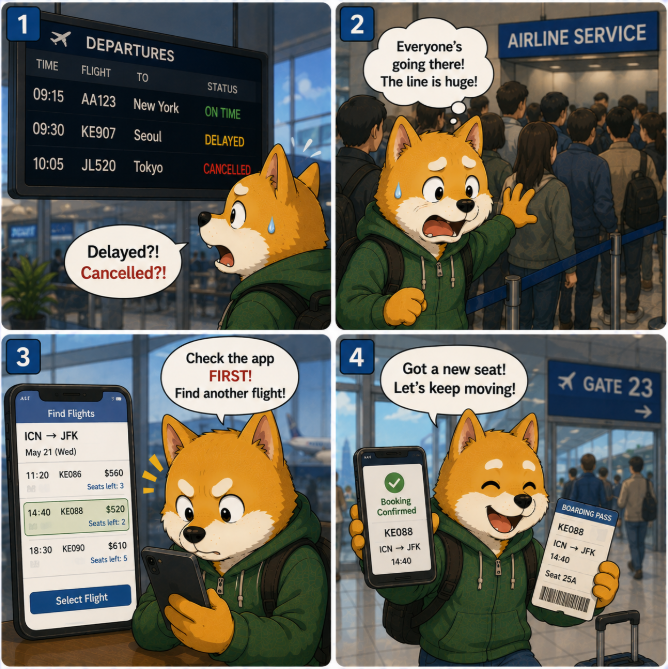
Check the app first.
Most banking apps now show suspicious transaction alerts or restriction status.
I once got blocked at an overseas ATM, and when I checked the app, there was a notification saying international withdrawals were blocked.
I approved it there, moved to another ATM, and the withdrawal worked immediately.
In the past, I kept changing machines without understanding the reason.
Now, the order is completely different.
So this is what I do.
After a withdrawal failure, my first action is checking the app.
Q. Are ATM differences really that significant?
A.
Much bigger than expected.
Some ATMs do not handle international cards well at all.
Especially smaller bank ATMs often have weaker foreign card compatibility.
I once succeeded only at the third ATM using the same card.
That changed my criteria.
I realized it might not be the card problem. It could be the ATM network.
So this is what I do.
After the first failure, I immediately switch to another ATM brand.
Q. Why is carrying only one debit card risky?
A.
Because access to cash can disappear instantly.
I once traveled with only one debit card, and it got blocked at an ATM.
At that moment, I had no cash, no backup card, and everything stopped.
What I realized was this.
The real problem was not the ATM failure. It was having no backup structure.
So this is what I do.
I prepare at least two cards for cash access.
Q. Can lowering the withdrawal amount solve the problem?
A.
Quite often.
Sometimes the ATM or bank treats a large withdrawal as risky.
I once failed trying to withdraw 500 dollars, then succeeded immediately after lowering it to 200 dollars.
Since then, when a large withdrawal fails, I reduce the amount first.
So this is what I do.
If I suspect a limit issue, I lower the withdrawal amount first.
Q. What should you do if the ATM keeps your card?
A.
That requires immediate action.
Once, late at night, my card stayed inside the ATM.
I immediately checked the bank number and blocked the card first.
If you simply leave, recovery becomes much harder.
So this is what I do.
If the ATM keeps the card, I contact the bank before leaving the location.
Q. What is the most common mistake people make?
A.
Repeating the same method over and over.
I used to think that if I kept trying at the same ATM, eventually it would work.
But abroad, changing the path matters much more than repeating.
Another ATM,
another card,
another amount.
Changing those solved problems much faster.
So this is what I do.
If something fails, I immediately switch to another path.
Q. Then how do you summarize the conclusion?
A.
It’s simple.
After an ATM failure,
the important thing is not repeating at the same machine.
It is changing the cash access path.
This is not a patience issue.
It is a recovery structure issue.
So this is what I do.
After ATM failure: app check → another ATM → another card.
Table
Published date
2026-05-11