You paid with a premium card.
It says “travel insurance included.”
So you skip additional insurance.
With this one choice,
if something happens, it is either solved at 0 dollars
or tens of thousands of dollars remain.
This is not a duplication issue.
It is about whether something is missing.
Q. If a card includes travel insurance, isn’t it fine to skip separate insurance?
A.
At first, I thought the same. Since the card description said travel insurance was included, I assumed there was no need to buy separate insurance.
Even when booking, I just thought, “It’s already covered,” and moved on.
But after one incident abroad, my criteria completely changed.
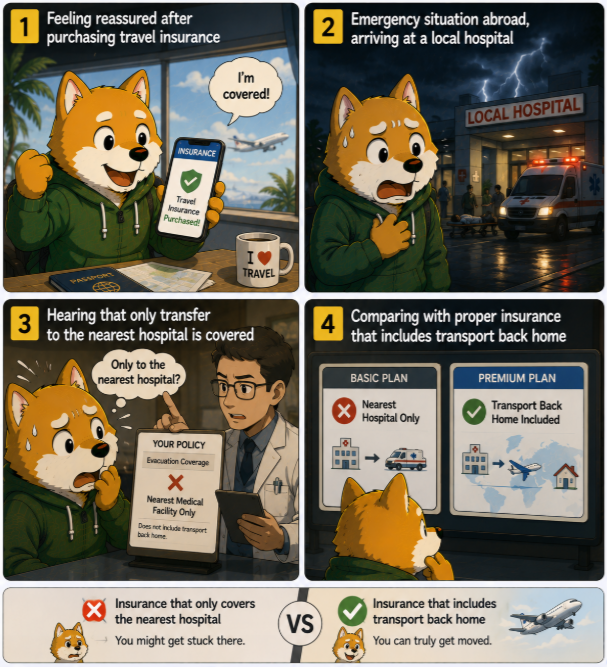
Someone traveling with me needed to go to a hospital, but almost nothing was covered by the card.
Cancellations or delays were partially covered, but treatment costs and transport costs were not included.
That’s when I first confirmed it.
Card insurance is structured to cover only part, not the whole.
So this is what I do.
I don’t trust the entire coverage just because the card has insurance.
Q. What exactly does card insurance cover?
A.
Mostly cancellations and delays.
For example, flight cancellations, schedule changes, rental car damage—these are covered to some extent.
I once had a rental car scratched, and it was handled through card insurance.
But the problem is medical.
Hospital costs abroad or emergency transport are usually not included or very limited.
I once relied only on the card and later confirmed that the parts I actually needed were missing.
So this is what I do.
I treat card insurance as basic protection and check the critical parts separately.
Q. Then what is different about separate travel insurance?
A.
The key is medical and transport.
Separate insurance includes hospital treatment, emergency situations, and even transport to another location.
This is where the costs become large.
I once saw someone injured abroad, and the transport cost was higher than the treatment.
That amount was tens of thousands of dollars.
After seeing that, my criteria changed.
This is not about inconvenience. It is about large loss.
So this is what I do.
If there is medical or transport risk, I look at separate insurance.
Q. Then isn’t it safer to have both card insurance and separate insurance?
A.
There is a lot of overlap.
Things like cancellation or delay are covered by both.
But in reality, only one applies.
I once had both, and in the end, there was a lot of overlap.
It felt like paying twice.
So this is what I do.
I remove overlapping parts and only fill what is missing.
Q. When is card insurance alone enough?
A.
Domestic travel, or when the amount is small and there is no medical risk.
For example, in domestic travel, you already have existing health coverage, and if the hotel is cancelable, there is no major issue.
In these cases, card insurance is enough.
I rarely use separate insurance for domestic trips.
There were almost no situations where I actually needed it.
So this is what I do.
If the risk is small, I rely on card insurance.
Q. On the other hand, when is separate insurance necessary?
A.
International travel, especially when there is medical risk.
If it’s not a city but a remote area, or a trip with a lot of activities, even more so.
In these cases, card insurance is not enough.
Now my criteria is clear.
If there is an area that the card does not cover,
I fill that part separately.
So this is what I do.
For international travel, I decide insurance based on medical criteria.
Q. Then how do you summarize the conclusion?
A.
It is simple.
Card insurance is partial protection.
Separate insurance is full protection.
This is not a choice issue.
It is a structure issue.
If something is missing,
there will be a moment when it becomes a problem.
So this is what I do.
If there is something the card does not cover, I fill it with insurance.
Published date
2026-04-27