You insert your card to pay,
and a choice appears on the screen.
Pay in USD
or in local currency.
If you press the wrong one here,
you just lose 5%.
This is not an exchange rate issue.
It is about who sets the exchange rate.
Q. Why does this option appear when paying abroad?
A.
At first, most people think like this: it looks easier in dollars, so just press USD. I used to think the same way. The numbers feel familiar, so it feels comfortable.
But one time, I paid in USD when checking out of a hotel in Europe. Later, when I saw my card statement, something felt off. The amount was higher than expected. A different exchange rate had been applied.
From that point, I started looking at the payment screen differently. This is not just a display issue. It is about who sets the exchange rate.
If the store or terminal sets it, there is already a margin built in.
So this is what I do.
I don’t choose what looks familiar. I first check who calculates the exchange rate.
Q. How much difference does it actually make? Is it noticeable?
A.
It looks small, but it grows quickly.
For example, if you pay around $1,000, paying in local currency means your card issuer handles it, and the fee is about 1%.
But if you pay in USD, it is usually around 4–5%.
That is a $40 difference.
A hotel stay and a few meals easily push it over $100.
I once traveled for two weeks without knowing this and kept paying in USD. When I calculated at the end, I had lost over $200.
What I realized was simple.
This is not a one-time mistake. It is a repeated loss.
So this is what I do.
The larger the amount, the more I always pay in local currency.
Q. Why is paying in USD more expensive?
A.
The structure is different.
If you choose USD, the store or payment company sets the exchange rate. There is usually a few percent margin included.
If you pay in local currency, Visa or Mastercard applies the rate. This is closer to the market rate and much more favorable.
I once split a payment at a restaurant. One in USD, one in local currency. The results were different.
The USD payment was more expensive, even though the amount was the same.
So this is what I do.
I always let the card network handle the exchange rate.
Q. Does the same issue happen at ATMs?
A.
Exactly the same. Even worse.
ATMs also show a message like “Convert to USD?”
If you press Yes, a high exchange rate is applied immediately.
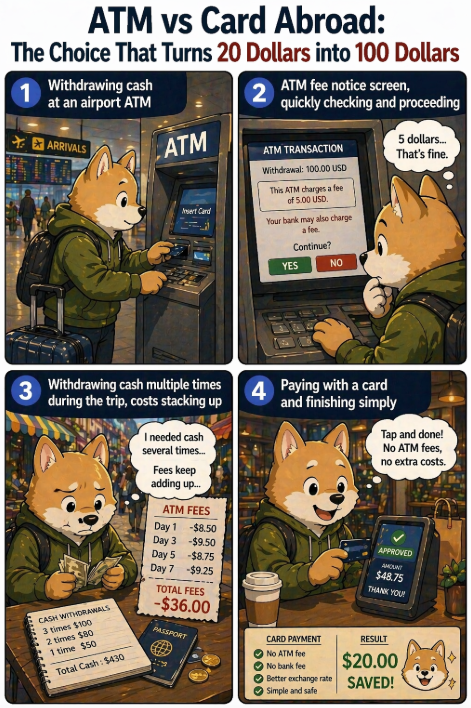
I once withdrew $500 at an airport ATM, and more than $530 was charged. That was over a 6% loss.
From that point, I set a rule.
So this is what I do.
At ATMs, I always withdraw in local currency.
Q. Is there ever a case where paying in USD is actually better?
A.
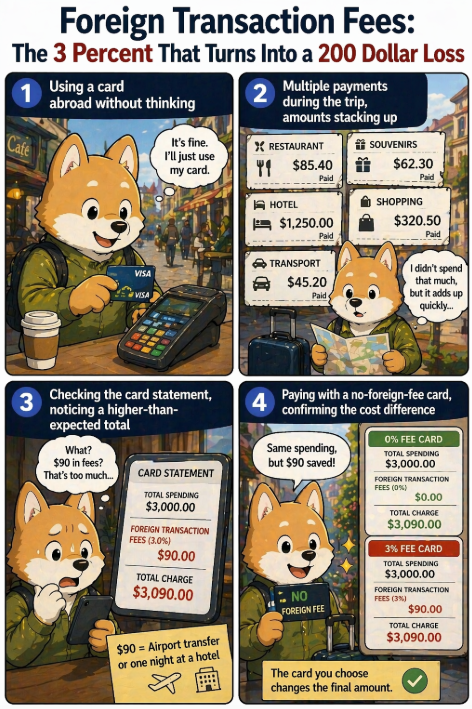
Almost none. There are rare exceptions. If your card has a high foreign transaction fee—say 3%—and the displayed exchange rate is below that, you could consider it.
But in reality, that rarely happens. Most of the time, it is simply more expensive.
And the important part is this: once you get confused, you repeat the same mistake. Because this choice appears every time you pay.
So this is what I do.
Instead of chasing exceptions, I fix the rule. I always pay in local currency.
Q. Then how would you summarize the rule?
A.
It’s simple.
Local currency means the card issuer sets the rate.
USD means the store sets the rate.
That difference is money.
So this is what I do.
If USD appears at payment, I don’t press it. I reject it and choose local currency.
Published date
2026-04-22