When you use a card while traveling,
3 percent gets added.
Most people just ignore it.
But that 3 percent
turns into 100 dollars, 200 dollars by the end of the trip.
This is not a fee.
It is money that keeps leaving.
Q. How much do foreign transaction fees actually add up to?
A.
At first, you barely notice it. Because it doesn’t show clearly at the moment of payment.
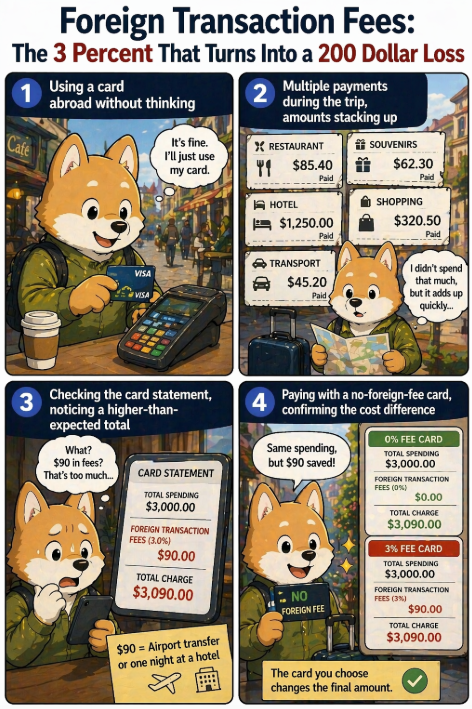
I also used to travel just using my card, and for the first time I calculated it after seeing my statement at the end.
The total spending was around $3,000, and more than $90 in fees had been added.
At the time, it felt like money already gone, but when I thought about it, it was the cost of an airport transfer or one night at a hotel.
The problem is that it’s not one time—it repeats. Meals, shopping, hotels, everything gets it.
So the longer the trip, the bigger the amount becomes.
So this is what I do.
When I’m abroad, I look at the fee structure before the payment amount.
Q. Why is there such a difference between cards?
A.
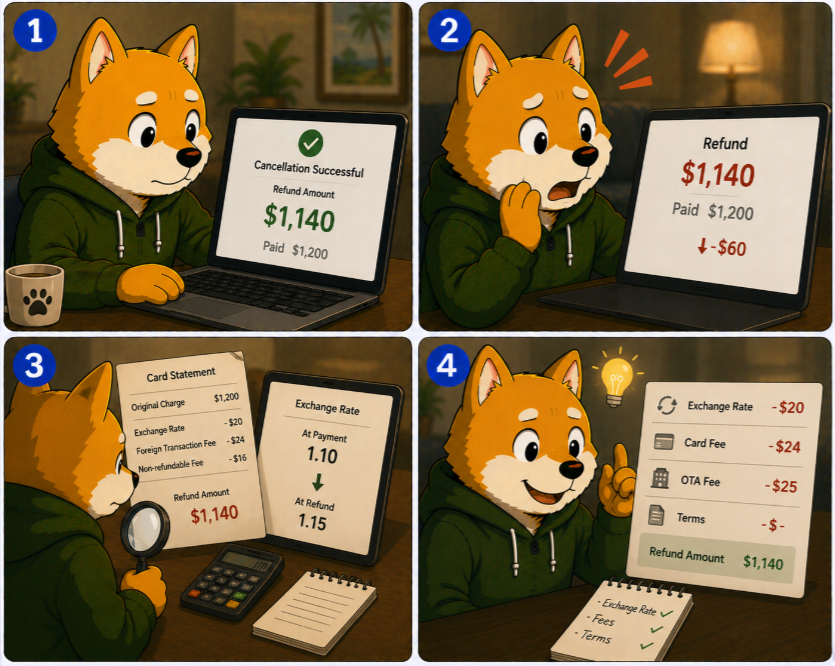
It looks like the same card payment, but in reality it happens in two steps.
First, the card network applies the exchange rate. A small cost is added there.
Then the issuing bank adds an additional fee.
The problem is the second part.
Some cards are 0 percent, some are 3 percent.
I once used two different cards on the same trip.
One had almost no fee, the other kept adding fees.
Same spending, different result.
So this is what I do.
I choose cards not by brand, but by fee structure.
Q. How big does the difference get in reality?
A.
It grows quickly.
For example, if you spend $5,000,
at 1 percent it’s $50,
at 4 percent it’s $200.
That’s a $150 difference.
This is not just a number. It is money you actually feel.
I experienced this on a family trip. If I had changed the card, that money would have remained.
So this is what I do.
Changing one card before the trip is much better.
Q. Is there a big difference between debit cards and credit cards?
A.
Yes.
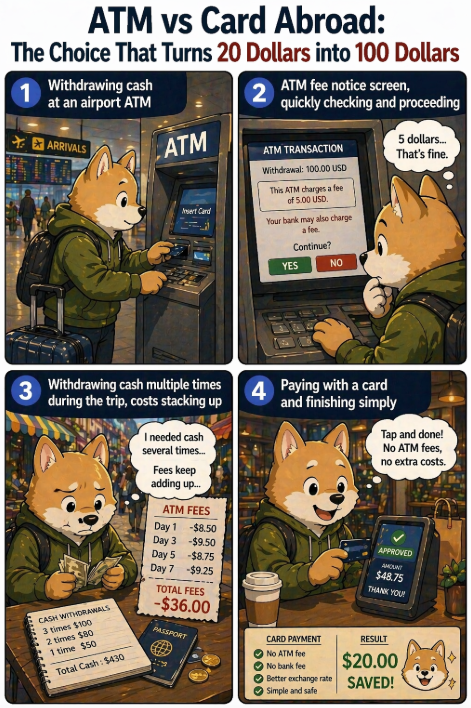
Debit cards usually have fees, and if you withdraw cash, additional costs are added.
I once paid with a debit card and also withdrew cash. Later I saw that money had been taken out twice.
Payment fee, ATM fee, and exchange loss all applied together.
What I realized was simple.
This is not a convenient choice. It is a choice that accumulates loss.
So this is what I do.
Abroad, I use credit cards as the default.
Q. Then what kind of card is the right choice?
A.
It comes down to three options.
If you want to reduce fees,
a 0 percent fee card.
If you want payment stability,
a card with a high approval rate.
If you want to remove risk entirely,
a two-card setup.
I currently use two cards.
If one fails, I switch immediately.
So this is what I do.
I change my card setup before traveling.
Q. If you don’t change this, does it keep repeating?
A.
It repeats exactly.
Same card,
same payment,
same fee.
I had the same loss on two consecutive trips.
That’s when I realized.
This is not a mistake. It is a structure.
So this is what I do.
I don’t keep using the same card.
Q. So how do you summarize the conclusion?
A.
The answer is already there.
If you use a 3 percent card,
you lose over 100 dollars by the end of the trip.
If you use a 0 percent card,
that money stays.
This is not something to hesitate about.
So this is what I do.
I change my card before the next trip.
Published date
2026-04-23