When you arrive at the airport,
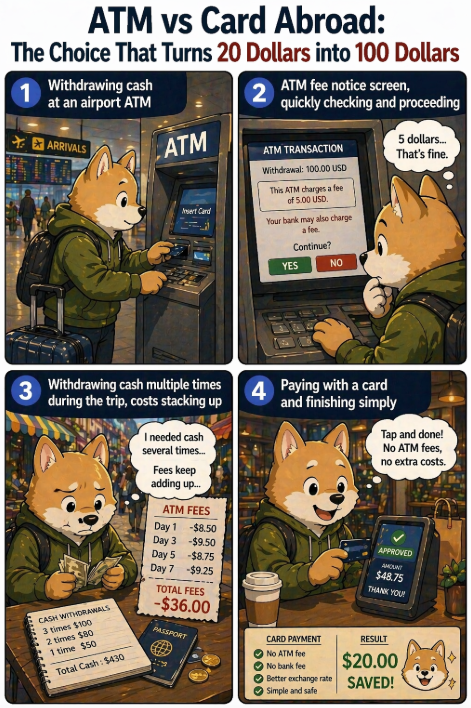
you almost immediately look for an ATM.
Because having some cash feels convenient.
But with this one choice,
the same trip can end up with over a 100 dollar difference.
This is not a payment method issue.
It is a structure where money leaks.
Q. Isn’t using an ATM abroad just normal?
A.
At first, I thought the same. I assumed I had to withdraw cash as soon as I arrived. Because of taxis, small shops, and tips.
So I withdrew 100 dollars at the airport, and kept withdrawing whenever I needed during the trip.
At the time, I thought it was just a few dollars in fees.
But after the trip, it felt different.
Every time I withdrew, there was a fee, and the exchange rate was unfavorable, and it kept repeating.
In the end, much more money had been taken than I expected.
That’s when I realized.
This is not about cash.
It is a structure where you pay fees multiple times.
So this is what I do.
I use ATMs once in a larger amount only when needed.
Q. Why does ATM usage become so expensive?
A.
It is not a one-time cost.
It usually adds up like this:
ATM machine fee
Bank fee
Exchange rate difference
These are not shown all at once—they are added separately.
I once withdrew 100 dollars three times,
and later saw that about 8 to 10 dollars was charged each time.
In total, nearly 30 dollars went to fees.
This gets worse with smaller amounts.
If you withdraw small amounts multiple times, the ratio increases.
So this is what I do.
I don’t withdraw small amounts repeatedly. If needed, I withdraw once in a larger amount.
Q. Then is using a card better?
A.
If the conditions are right, it is much better.
Especially with a no-fee card, the difference is clear.
On the same trip, I once paid 400 dollars by card and withdrew 400 dollars from an ATM.
The results were different.
The card had almost no cost,
and the ATM kept adding fees.
The difference was about 15 to 20 dollars.
If this repeats throughout the trip, the amount grows.
So this is what I do.
Wherever payment is possible, I always use a card.
Q. But aren’t there situations where cash is necessary?
A.
Yes.
Markets, small shops, transportation—some places don’t accept cards.
But the problem is carrying too much cash because of that.
I once withdrew more than needed
and ended up not using it all.
That is just money tied up.
So I changed my rule.
Cash only as much as needed,
card as much as possible.
So this is what I do.
Cash is for backup, and the default is card.
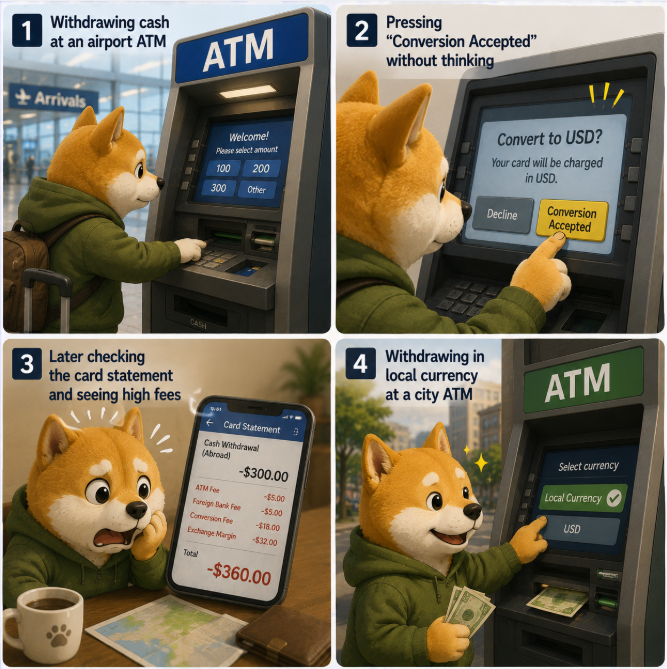
Q. There’s also an option at ATMs to convert to USD. What about that?
A.
That is the most dangerous.
When an ATM asks “Convert to USD,”
the moment you press Yes, it becomes more expensive.
I pressed it once
and lost over 6 percent.
I withdrew 300 dollars, and nearly 20 dollars extra was taken.
From then on, the rule is clear.
So this is what I do.
At ATMs, I always choose local currency.
Q. Then how do you summarize the conclusion?
A.
It is simple.
Card ends in one step.
ATM keeps adding.
Card has small costs,
ATM grows through repetition.
This is not about preference.
It is about structure.
So this is what I do.
If possible, I pay by card,
and withdraw cash only once in the amount needed.
| Repeated withdrawals | Fees accumulate |
| One large withdrawal | Cost reduced |
| Use card | Cost minimized |
| Select USD | Exchange loss + extra cost |
Published date
2026-04-23