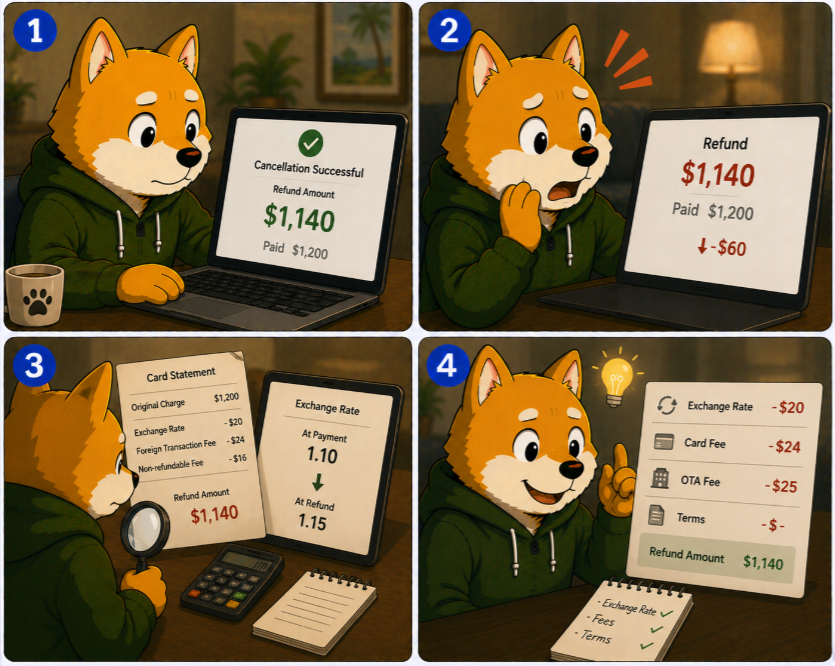
You check the refund amount.
You clearly paid 1200 dollars,
but 1140 dollars comes back.
You immediately think,
“Is this a mistake?”
But most of the time, it’s not.
This is not a refund issue.
It is a structure of how money was taken out.
Q. If the refund amount is different, isn’t it just an error?
A.
At first, it feels that way. I also thought it was a problem when I received a lower refund after canceling a hotel.
I paid 1200 dollars, but received 1140 dollars.
On the surface, 60 dollars disappeared.
So I checked both the card company and the hotel.
The conclusion was simple. There was no issue.
That’s when I started checking one by one.
The exchange rate had changed,
card fees had been deducted,
and some fees were not refundable.
At that moment, I understood.
The refund was not reduced. The cost had already been taken out.
So this is what I do.
If the refund is different, I check the structure first.
Q. Does exchange rate really make a noticeable difference?
A.
More than expected.
For example, if you pay 1000 euros at a rate of 1.10, that is 1100 dollars.
If the rate becomes 1.15 at refund, it becomes 1150 dollars.
If the rate drops, you receive less.
I once had about a 40 dollar difference due to exchange rate.
At that time, I didn’t understand it and was confused, but later it was just exchange rate.
So this is what I do.
For foreign currency payments, I include exchange rate in my thinking.
Q. Do card fees also affect the refund?
A.
Significantly.
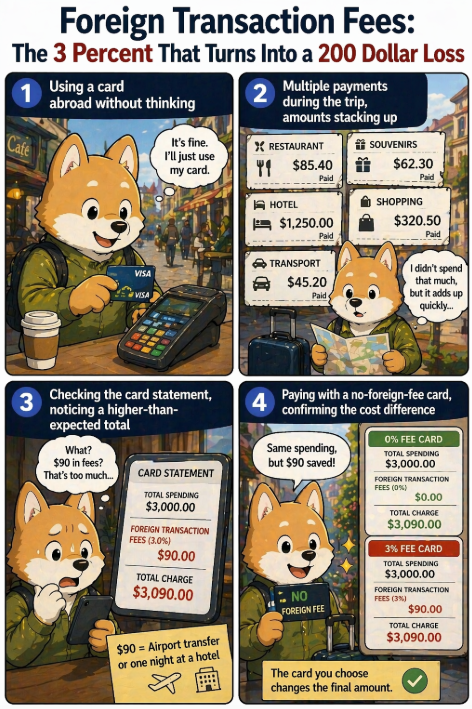
International payments usually include a 1–3 percent fee.
The problem is that these fees are often not refunded.
I once paid about 36 dollars in fees on a 1200 dollar payment.
When refunded, I received 1200 dollars, but the fee was gone.
What I realized was simple.
This was not a refund issue. The cost was already fixed.
So this is what I do.
I treat card fees as non-refundable.
Q. Can OTA bookings create more differences?
A.
Yes.
OTA platforms may include their own fees.
I once canceled a hotel booked through a platform and saw about a 25 dollar difference.
After checking, the platform fee was not refundable.
What I realized was this.
This was not a hotel issue. It was a booking structure issue.
So this is what I do.
I assume refund structure differs by booking channel.
Q. Even with “free cancellation,” can there still be differences?
A.
Yes.
Free cancellation usually applies to the room rate only.
Other attached costs are handled separately.
I once relied on “free cancellation,” but the final refund amount was different due to exchange rate and fees.
That’s when my criteria changed.
Free cancellation is not full refund. It is conditional refund.
So this is what I do.
I focus on the structure, not the word “free.”
Q. Then when should you consider it an actual problem?
A.
When the difference is too large.
If it exceeds about 10 percent or cannot be explained, it should be checked.
I once had an actual error due to double charge.
In that case, I contacted the card company and resolved it.
So this is what I do.
Small differences are structure. Large differences need verification.
Q. Then how do you summarize the conclusion?
A.
It’s simple.
If the refund amount is different,
it is not an error. It is structure.
Exchange rate, fees, and contract terms
create the difference.
So this is what I do.
If the refund is lower, I check the reason first.
Published date
2026-05-07