You tap your card.
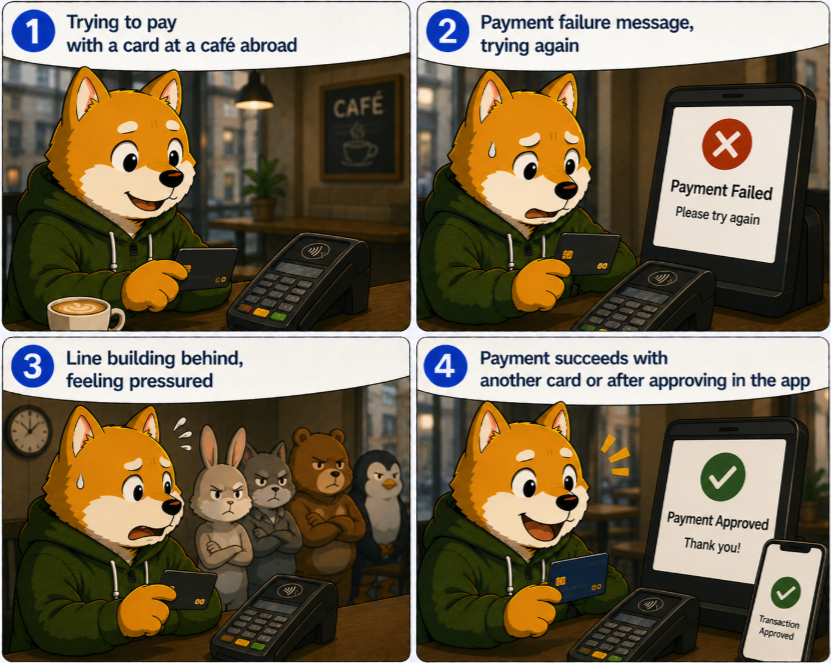
Payment failed.
Most people immediately try again.
But from that moment,
the problem gets bigger.
This is not about the card not working.
It is about the order of your next actions.
Q. If a card payment fails, shouldn’t you just try again?
A.
Most people react that way. I used to do the same. If it failed once, I simply tapped again.
But abroad, that often made the situation worse.
Once, my card was declined at a restaurant abroad, and I kept retrying with the same card.
The result was repeated failure.
Meanwhile, the line behind me kept growing, and the staff were waiting.
Later, I found out the bank had already triggered a security block, and repeated attempts made the block even stronger.
What I realized was simple.
This was not a payment failure. It was a failure of response order.
So this is what I do.
After the first failure, I don’t immediately retry.
Q. What should you do first when a card gets declined?
A.
Check the app immediately.
Now, most banking apps send suspicious transaction alerts right away.
I once had a card blocked during hotel check-in, and when I opened the app, there was an approval request waiting.
I pressed confirm and retried the payment, and it went through immediately.
In the past, I kept retrying without knowing the reason.
Now, the order is completely different.
So this is what I do.
After a payment failure, my first action is checking the app.
Q. Why is repeatedly trying the same card a bad idea?
A.
Because the banking system sees it as a risk pattern.
If the same transaction repeats within a short period, it may be treated as suspicious activity.
I once kept retrying a taxi payment at the airport, and the card became fully locked.
At that point, even app approval stopped working, and I had to use another card.
So this is what I do.
After one failure, I don’t repeat attempts until I understand the reason.
Q. Why are backup cards so important?
A.
Because the dangerous part is not the failure itself.
It is the moment everything stops.
I once had a card fail during hotel check-in, but I switched to another card immediately and solved it without issue.
On the other hand, in the past, I traveled with only one card and ended up waiting in the lobby trying to contact the bank.
The difference was enormous.
So this is what I do.
When traveling abroad, I always carry at least two cards.
Q. Does the response method change depending on the situation?
A.
Completely.
At hotel check-in, delays become dangerous because the reservation itself may be affected.
For taxis, movement stops.
At ATMs, cash flow itself gets blocked.
I once had an ATM card blocked late at night and completely lost access to cash.
Without another card, it would have become a serious situation.
So this is what I do.
Depending on the situation, I switch to another payment method immediately.
Q. What is the most common mistake people make?
A.
Repeating the same action while trying to solve the problem.
I used to think that if I kept trying, eventually it would work.
But abroad, switching paths mattered more than persistence.
Checking the app,
using another card,
moving to cash.
That sequence solved problems much faster.
So this is what I do.
Instead of repeating, I look for another path first.
Q. Then how do you summarize the conclusion?
A.
It’s simple.
After a payment failure,
the important thing is not continuing to retry.
It is quickly moving to another path.
This is not a persistence issue.
It is a recovery structure issue.
So this is what I do.
After the first failure: app check → one retry → immediately switch to another card.
Published date
2026-05-11