You tap your card.
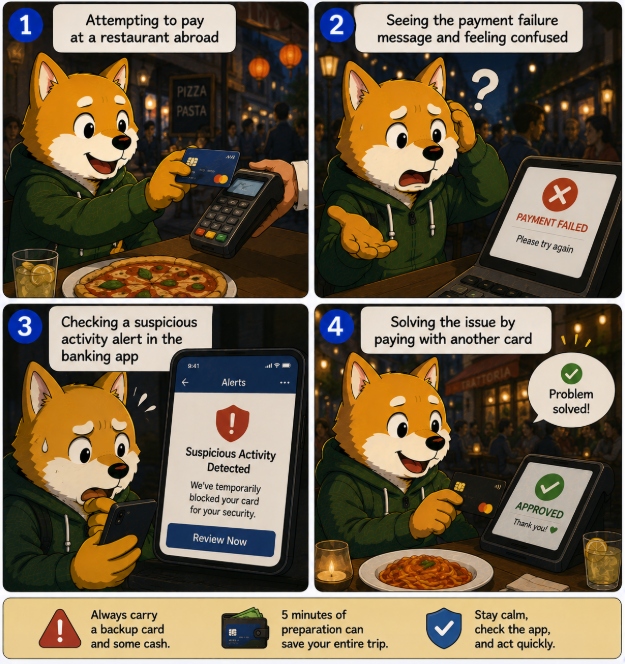
Payment failed.
You try again.
Failed again.
At that moment, you think,
“Is my balance too low?”
But most of the time, that’s not it.
This is not a money issue.
It is a bank block.
Q. Isn’t a declined card abroad just because of insufficient balance?
A.
At first, everyone thinks that. When my card didn’t work abroad for the first time, I immediately checked my balance. There was enough money, but the payment kept failing.
I thought it was a machine issue and tried at another store. The result was the same.
The most confusing part is not knowing the reason.
Later, I found out the bank had blocked the transaction.
Because a large amount appeared suddenly in a foreign country, it was flagged as suspicious.
What I realized was simple.
This was not a payment failure. It was a block.
So this is what I do.
If a payment fails, I don’t assume it’s a money issue first.
Q. Why does this happen more often abroad?
A.
Because the pattern changes.
A country you don’t usually use your card in,
a different type of merchant,
a larger-than-usual amount.
When these three happen together, the bank sees it as a risk.
I once tried to pay for a hotel right after arriving at the airport, and it was blocked.
The amount was large, and the location was new.
Check-in itself was delayed.
So this is what I do.
For the first transaction, I test with a small amount.
Q. What should you do immediately when your card is blocked?
A.
In most cases, it can be resolved quickly.
Now, when this happens, I check the app first.
There is usually a suspicious activity alert.
With one confirmation tap, it often gets resolved.
In the past, I had to call the bank, but now it is usually handled through the app.
So this is what I do.
If a payment fails, I check the app first.
Q. Are debit cards more risky?
A.
They are more unstable.
Debit cards are directly linked to your funds, so the security threshold is stricter.
I once traveled with only a debit card and had multiple payment failures.
At that point, I had no option but to use cash.
After that, my criteria changed.
So this is what I do.
Abroad, I use credit cards as the default.
Q. Can multiple small transactions also trigger a block?
A.
Yes.
If you make several transactions in a short time, the pattern can look unusual.
I once paid for a café, convenience store, and transport in quick succession and got blocked in between.
The amounts were small, but the frequency triggered it.
So this is what I do.
I avoid repeated transactions in a short period.
Q. Does this affect hotels or rental cars as well?
A.
It has a big impact.
Hotels and rental cars usually place additional holds.
This reduces your available limit even if it’s not an actual charge.
I once had a 300 dollar hold at a hotel and another hold at a rental car.
My available credit dropped significantly.
After that, payments kept failing.
So this is what I do.
Before large payments, I check my available limit.
Q. Then how do you summarize the conclusion?
A.
It’s simple.
If your card doesn’t work,
it’s not that you don’t have money,
it’s that it’s blocked.
This is not an error.
It is protection.
So this is what I do.
When traveling abroad, I always carry at least two cards.
Published date
2026-05-07