When booking a hotel,
this always appears.
Pay now is cheaper.
Pay later is more expensive.
The difference is about 10 dollars per night.
But that’s not the real issue.
With this one choice,
it’s not tens of dollars—
hundreds of dollars can be lost.
This is not a payment method.
It is a choice of buying risk.
Q. Why does prepayment look so attractive?
A.
At first glance, it’s simple. Same room, lower price. If the difference is about 10 dollars per night, you just choose it. I did the same.
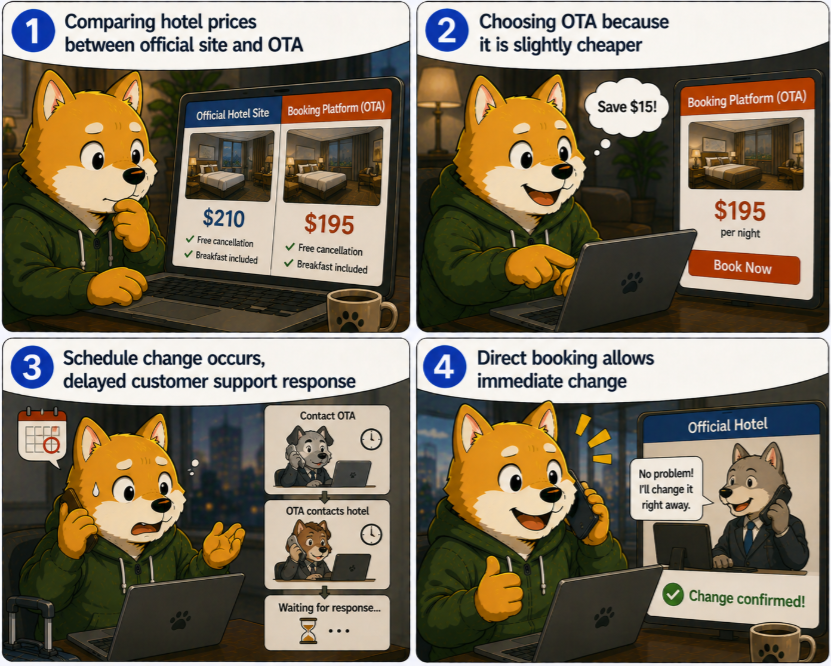
On a trip to Europe, I booked four nights and saved 15 dollars per night, so I paid immediately. That was a total of 60 dollars saved. At the time, I thought it was a good decision.
But the problem came later. My flight time changed, and my schedule got disrupted. I had to adjust the hotel dates. But it was already paid, and it was non-refundable.
As a result, nearly 800 dollars was locked.
What I realized was simple.
I tried to save 60 dollars and lost 800 dollars.
So this is what I do.
I look at how much I can lose before how much I can save.
Q. What does it mean to consider exchange rates as well?
A.
This matters more than expected.
When you prepay for a hotel abroad, the exchange rate is fixed at that moment.
For example, if you book 2500 dollars at an exchange rate of 1.10, it becomes 2750 dollars.
But if the rate later drops to 1.05, the same booking becomes 2625 dollars.
That’s a 125 dollar difference.
On the other hand, if the rate goes up, you could benefit.
In the end, this is not just a booking.
It is a choice about exchange rates.
After experiencing this once, my thinking changed.
So this is what I do.
I don’t try to time exchange rates. I look at the structure of the choice.
Q. Then when is prepayment the right choice?
A.
Only when conditions match.
When the schedule is fixed,
when cancellation is unlikely,
when the amount is large.
If all three apply, it makes sense.
For example, on business trips where dates never change, I prepay. In that case, it increases stability.
But for most travel, these conditions do not apply.
So this is what I do.
If the schedule is not fixed, I do not prepay.
Q. For most trips, which option is better?
A.
In most cases, pay later is better.
The reason is simple. Schedules always change.
Flight times change, routes change, plans themselves change.
I once had to change plans during a trip. A hotel I booked with pay later could be canceled immediately, and I moved to another place.
That day, I moved without any loss.
What I realized was this.
This is not about price. It is about optionality.
So this is what I do.
For travel, I set pay later as the default.
Q. If the discount is small, isn’t it okay to prepay anyway?
A.
That is the most dangerous thinking.
15 dollars a day looks small.
But over 4 days, that’s 60 dollars.
The problem is that to save that 60 dollars, you lock the entire amount.
I once prepaid to save 50 dollars and ended up losing 700 dollars.
That’s when my standard changed.
This is not saving. It is risk.
So this is what I do.
I ignore small discounts and choose flexibility.
Q. Then how do you summarize the conclusion?
A.
The answer is already there.
A small discount cannot beat flexibility.
Only a fixed schedule can beat prepayment.
This is not something to debate.
The outcome is already determined.
So this is what I do.
If the schedule is not fixed, I do not pay now.
Published date
2026-04-23