Your wallet is gone abroad.
No cards,
no cash,
no ID.
From that moment,
the problem is no longer one missing item.
Payments,
identity verification,
transportation,
reservations.
Everything becomes unstable at once.
This is not a loss issue.
It is about how quickly you protect the access you still have left.
Q. What should you do first if you lose your wallet abroad?
A.
At first, most people only try to find it again. I used to do the same. I kept wondering if I left it in a restaurant, dropped it in a taxi, or misplaced it inside my bag.
But while doing that, time passes.
That time is dangerous.
Once, I lost a wallet containing cards abroad. For the first ten minutes, I focused only on searching for it.
Then suddenly I realized the cards might already be usable by someone else.
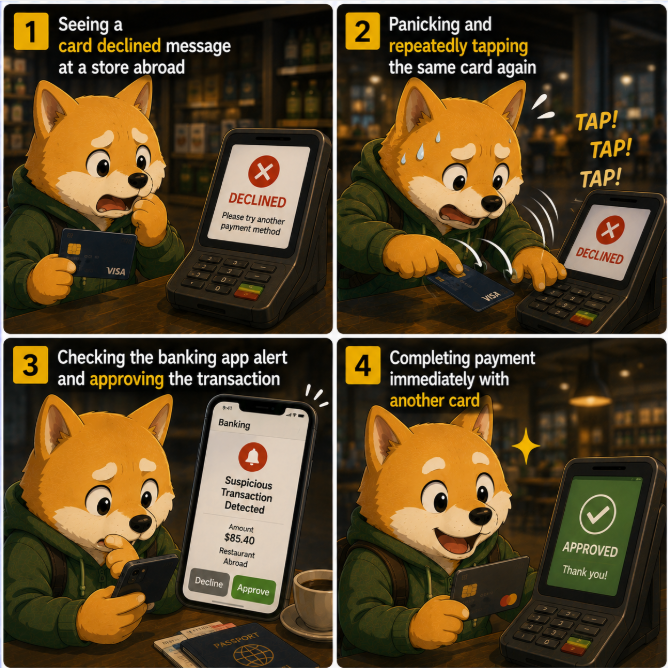
At that moment, I immediately opened the banking app and locked the cards.
Fortunately, there were no approved transactions.
What I realized was simple.
Before finding it, you need to block access first.
So this is what I do.
The moment I confirm the wallet is gone, I lock the cards first.
Q. Should you contact the card company immediately, or use the app first?
A.
If the app works, the app comes first.
Phone support takes time. Abroad, signal can be unstable, and customer service may not connect quickly.
Once, I waited over 15 minutes just trying to reach the card company.
By contrast, locking the card in the app took less than one minute.
That difference was enormous.
After that, my criteria changed.
Before calling, I block access through the app first, then contact support if necessary.
So this is what I do.
Immediately after loss, I lock the card through the banking app first.
Q. Is it much more dangerous if IDs are also inside the wallet?
A.
Much more dangerous.
Cards can be locked. IDs cannot be restored immediately.
Hotels, flights, rental cars, and some transportation services may require identity verification.
Once, I got through a hotel situation because I had stored passport copies separately.
It wasn’t the original document, but together with reservation and card information, the staff accepted the verification process.
What I realized was this.
You do not prepare ID copies after losing them. You prepare them before losing them.
So this is what I do.
I save copies of passports and IDs both on my phone and in the cloud.
Q. What if you lose your cash too?
A.
Then you immediately check your remaining payment paths.
Once, when I lost my wallet, even my small amount of cash disappeared with it.
The first thing I checked was which cards I still had left.
Fortunately, I had placed a backup card separately in another part of my bag.
With that single card, I reached my hotel and later withdrew more cash.
If all my cards had been inside one wallet, the trip would have stopped immediately.
So this is what I do.
I never keep all cards and cash in one place.
Q. What if all your cards are gone?
A.
Then you must create emergency cash access immediately.
If you still have access to banking apps, you first lock the cards, then look for transfers, family support, or international money transfer services.
Once, during a trip, I solved the situation by receiving money from someone traveling with me and converting it into local cash.
Solo travel makes this much harder.
That’s why at least one of these must always exist separately:
backup card, digital card, or emergency cash.
What I realized was simple.
Losing one wallet should not destroy the entire payment system.
So this is what I do.
When traveling abroad, I always separate backup payment methods.
Q. Should you also file a police report immediately after the loss?
A.
Depending on the situation, yes.
If it is only cards and they are already locked, bank action comes first.
But if passports, IDs, large cash amounts, or theft indications are involved, an official report may become necessary.
Once, I saw a situation where an insurance claim required a police loss report.
Without that record, the explanation process became much more complicated.
So this is what I do.
If IDs or large amounts are involved, I leave an official report record.
Q. What is the most common mistake people make?
A.
Continuing to search without taking control first.
Of course you should search.
But first you block access.
Lock the cards,
check remaining payment methods,
move to a safe place,
then continue searching.
I used to focus only on the lost item itself.
But abroad, access matters more than the object.
Can I still pay?
Can I still prove my identity?
Can I still reach my accommodation?
Those three matter first.
So this is what I do.
Immediately after loss, I prioritize control before searching.
Q. Then how do you summarize the conclusion?
A.
It’s simple.
The moment the wallet disappears,
the wallet itself is no longer the most important thing.
What matters is protecting:
remaining cards,
remaining cash,
remaining identity verification methods.
This is not a loss issue.
It is about preventing the entire travel system from collapsing.
So this is what I do.
If the wallet disappears, I immediately move in this order: lock cards → check remaining payment methods → move to a safe location.
Published date
2026-05-12