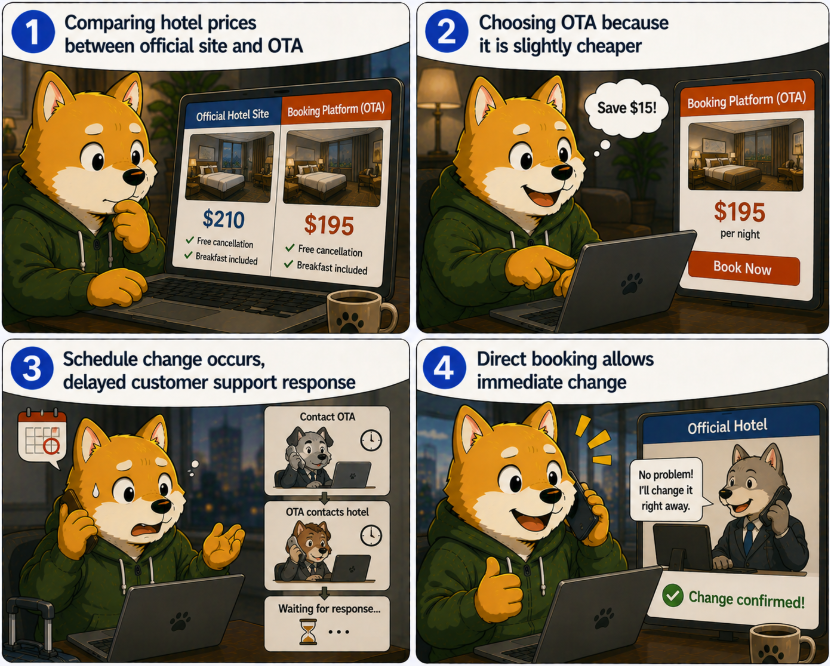
You check the hotel price again after booking.
The same room is cheaper.
About 20 dollars per night,
around 60 dollars total difference.
Most people change it right away.
But with this one choice,
you try to save 60 dollars
and end up locking the entire amount.
This is not a price issue.
It is about changing the conditions.
Q. If the price drops after booking, isn’t it right to just rebook?
A.
At first, I did the same. If it’s cheaper, it feels obvious to change it.
Once, I booked a hotel and checked again a few days later, and the price had dropped. It was about a 75 dollar difference for three nights.
So I canceled the original booking and rebooked immediately.
At that time, I thought it was a good decision.
But later, a problem came up. My schedule shifted by a day, and I had to change the hotel dates. The new booking was non-refundable.
In the end, the original booking was flexible, but by changing it, I moved into stricter conditions.
What I realized was this.
The price went down, but the option disappeared.
So this is what I do.
Before price, I check whether the conditions change.
Q. Then is it often better to leave it even if the price drops?
A.
It depends on the conditions.
If the original booking is refundable, it’s different.
I once had a flexible booking, saw the price drop, canceled it, and rebooked.
That time, I saved 90 dollars with no loss.
The problem is when it’s non-refundable.
In that case, changing it means giving up the original booking.
So this is what I do.
If it’s flexible, I change it. If not, I leave it.
Q. When do people make the biggest mistake?
A.
When they decide based only on price.
I once changed a booking to save 60 dollars, and later lost 600 dollars when my schedule changed.
When I calculated it, it was simple.
To save 60 dollars, I had put 600 dollars at risk.
The problem is that you don’t see it at that moment.
You only see the price drop.
So this is what I do.
Before savings, I look at the worst-case loss.
Q. Can exchange rates also affect this?
A.
Yes, especially for international bookings.
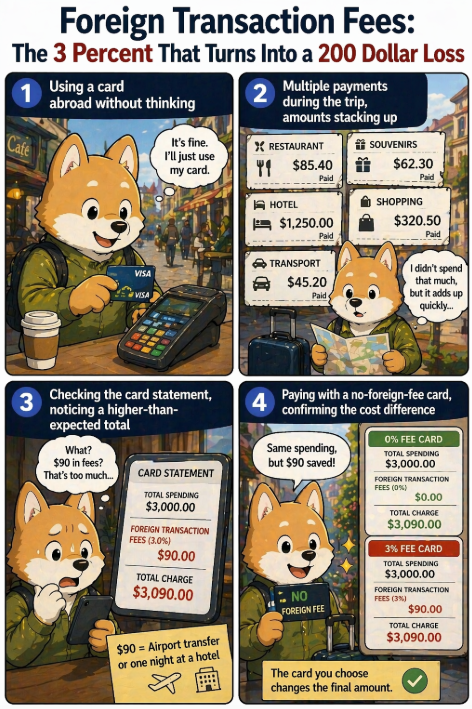
For example, the price in euros may drop, but if the exchange rate rises, the actual payment may be the same or even higher.
I once thought the price dropped and changed it, but the card charge was almost the same.
What I realized was simple.
Not the displayed price, but the actual charged amount matters.
So this is what I do.
I look at the total cost including exchange rates.
Q. Do hidden costs like resort fees also matter?
A.
Yes.
Often, only the base rate drops while the resort fee stays the same.
I once thought I saved 25 dollars, but due to the resort fee, the actual saving was almost nothing.
This is not a price issue.
It is a structure issue.
So this is what I do.
I compare based on total cost, not base rate.
Q. Then how do you summarize the conclusion?
A.
It’s simple.
I don’t change just because the price dropped.
I change only when the conditions stay the same.
This is not a savings issue.
It is a risk issue.
So this is what I do.
If it is not refundable, I never rebook.
Published date
2026-04-29