You arrive abroad.
The phone works normally.
So you use it like usual.
Checking maps,
watching videos,
uploading photos.
But because of that one connection,
the bill explodes a few days later.
This is not a data issue.
It is about not realizing the phone was automatically connected.
Q. Do people still really get hit with huge roaming bills abroad?
A.
Much more often than expected. I used to think, “These days, it should all be fine.”
But in reality, international data often stays enabled automatically.
Once, after arriving abroad, I kept using maps, social media, and videos like normal.
The problem was that what I thought was Wi-Fi was actually roaming data.
A few days later, I checked the bill, and the amount was far larger than expected.
What I realized was simple.
The problem was not heavy data usage. It was using the network without knowing what connection I was on.
So this is what I do.
Before departure, I check roaming settings first.
Q. Why does this mistake keep happening?
A.
Because phones connect too naturally.
As soon as you arrive abroad, the phone automatically connects to a local carrier.
People see internet access working and immediately relax.
Once, I thought I was connected to airport Wi-Fi and kept using the internet, but it was actually roaming data.
That completely changed my criteria.
I stopped checking whether the internet worked
and started checking what network it was.
So this is what I do.
When internet works, I check the network status first.
Q. Can even maps and messaging create large charges?
A.
Depending on the situation, yes.
Automatic updates, photo backups, and video autoplay consume much more data than expected.
Once, I traveled while cloud photo syncing was still enabled, and data usage kept increasing continuously.
At that point, background data became a bigger problem than active usage itself.
So this is what I do.
Before traveling abroad, I disable automatic backups and automatic updates.
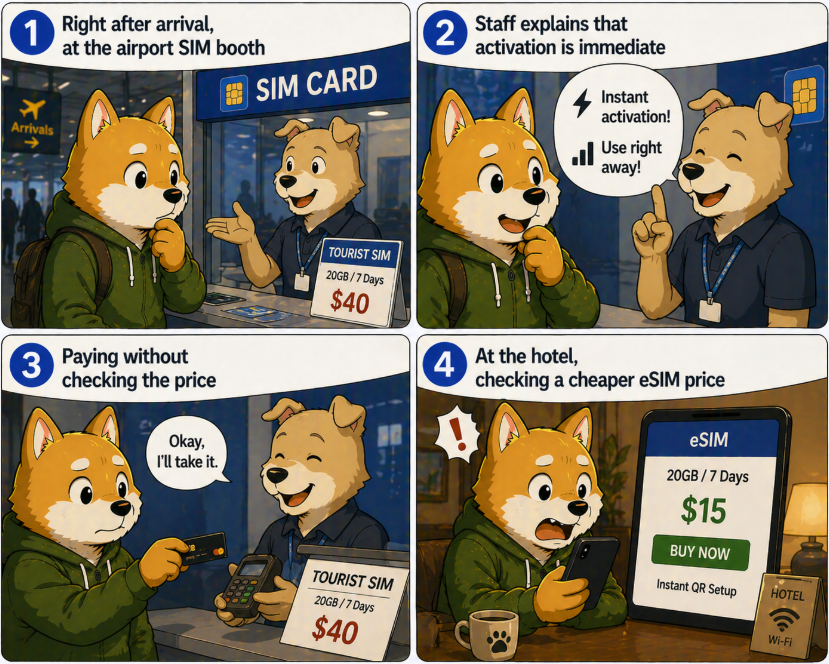
Q. Why are eSIMs or local data plans safer?
A.
Because the pricing structure is much clearer.
You know exactly how much data and how many days are included.
By contrast, traditional roaming often continues connecting automatically without people noticing.
Once, after switching to eSIM, I actually found data usage much easier to control.
Since then, abroad, I check local data structures before roaming.
So this is what I do.
For international data, I choose fixed-cost structures instead of automatic roaming connections.
Q. Is the moment right after arriving at the airport the most dangerous?
A.
Very dangerous.
Right after arrival, people are distracted and start using their phones immediately as long as there is a connection.
In that state, they rarely check data usage carefully.
Once, at the airport, I used maps, translation apps, and ride apps simultaneously, and the data usage increased rapidly in a short period.
What I realized was simple.
At airports, checking data status matters more than simply getting connected.
So this is what I do.
Immediately after arrival, I check the data connection status first.
Q. What is the most common mistake people make?
A.
Thinking, “Using it for just a moment should be fine.”
I used to think a few minutes would not matter.
But abroad, even short usage keeps accumulating.
Especially with automatic connections, background data continues moving without people realizing it.
So this is what I do.
Even for short usage, I clearly confirm international data status first.
Q. Then how do you summarize the conclusion?
A.
It’s simple.
International roaming problems
do not happen because people intentionally use huge amounts of data.
They happen because people use data without knowing what connection they are on.
This is not a data issue.
It is a communication structure issue.
So this is what I do.
Before departure, I configure roaming status, automatic updates, and data connection methods first.
Published date
2026-05-18